
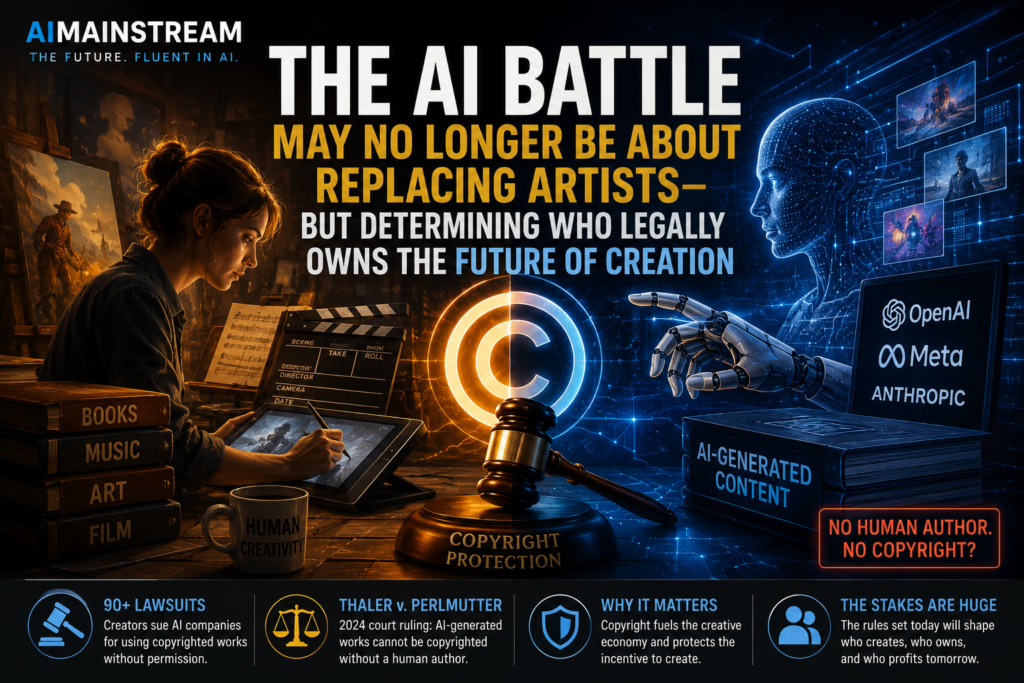
The AI battle may no longer be about replacing artists — but determining who legally owns the future of creation
What’s Happening
A growing legal war between creators and artificial intelligence companies is beginning to reshape the future of creative labor.
More than 90 lawsuits have reportedly been filed against AI firms including OpenAI, Meta, and Anthropic over claims that copyrighted books, articles, music, artwork, and other creative materials were used without permission to train AI systems.
At the center of the debate is a deeper legal and economic question:
Can AI-generated work itself receive copyright protection?
That issue gained major attention in the 2024 court case Thaler v. Perlmutter, where a federal appeals court ruled that fully autonomous AI-generated works cannot currently qualify for copyright protection because U.S. copyright law requires a human author.
The decision reinforced one of the most important protections inside the creative economy:
human ownership.
But it also opened a far larger gray area.
As AI tools become increasingly integrated into writing, filmmaking, music production, design, journalism, and advertising, regulators still have not clearly defined how much AI involvement is allowed before a work loses copyright eligibility.
That uncertainty is becoming one of the most important legal battles in modern media.
Why It Matters
The future of AI content may depend less on technology — and more on ownership rights.
Copyright protection is the financial backbone of creative industries.
Studios, publishers, labels, streaming companies, and media firms rely on copyright law to:
- license content,
- control distribution,
- protect intellectual property,
- monetize franchises,
- and prevent unauthorized duplication.
Without clear ownership rights, the economic incentive behind large-scale creative production becomes far weaker.
That may explain why many major entertainment companies continue emphasizing human involvement despite rapid advances in generative AI.
The issue is no longer simply:
“Can AI create content?”
The bigger question is:
“Can anyone legally own what AI creates?”
If courts continue limiting copyright protections for fully AI-generated material, companies may be forced to keep humans embedded inside creative workflows — not necessarily for artistic reasons, but for legal and commercial survival.
Who Benefits
- Human creators whose involvement preserves copyright eligibility
- Studios, publishers, and labels protecting monetizable IP
- Lawyers and regulatory firms specializing in AI intellectual property
- Hybrid human-AI creative workflows that maintain legal ownership protections
Who Loses
- Companies seeking fully autonomous AI content pipelines
- Platforms flooded with low-value, non-protected AI-generated media
- Creators whose copyrighted work may have been used without consent
- Businesses hoping AI alone could replace large portions of creative labor
What Happens Next
The next stage of the AI economy may become a legal infrastructure battle — not just a technology race.
Future regulations and court rulings could determine:
- how much human contribution is legally required,
- whether AI-assisted works qualify for copyright,
- how training data can be used,
- and who ultimately owns AI-generated media.
That could reshape the economics of film, music, journalism, publishing, gaming, advertising, and digital entertainment for decades.
AI can now generate content at massive scale.
But the industries built around creativity still depend on one thing AI may not fully replace:
legal human authorship.