
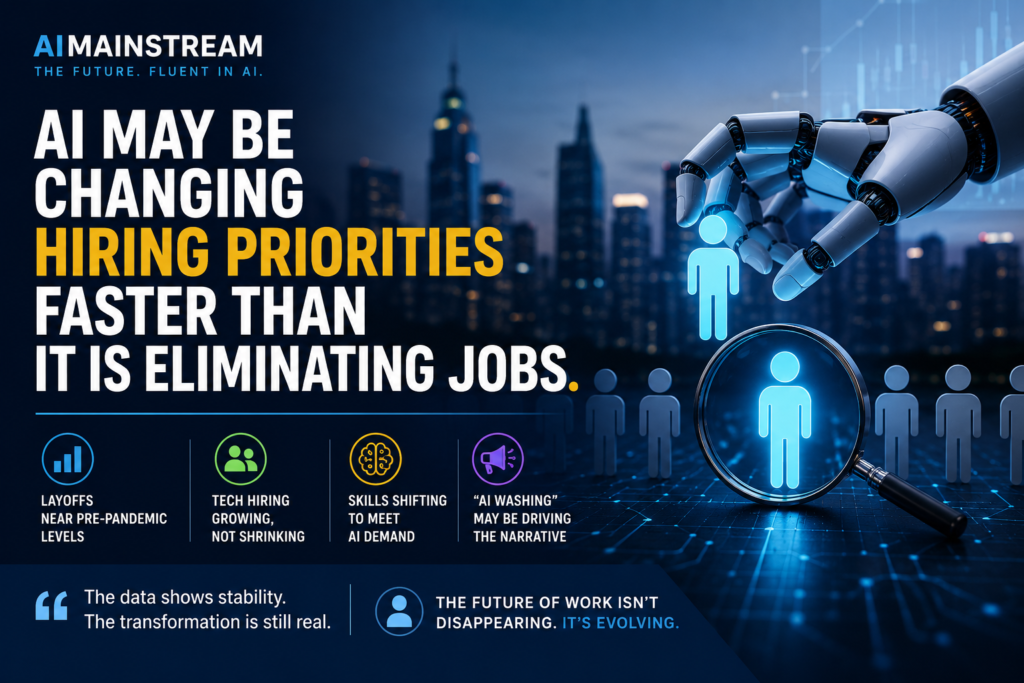
AI may be changing hiring priorities faster than it is eliminating jobs.
What’s Happening
Despite growing fears surrounding artificial intelligence and mass unemployment, new labor data suggests the broader U.S. layoff environment remains relatively stable.
According to reporting from The Washington Post, layoffs across the United States are hovering near pre-pandemic norms when adjusted for workforce size. In March, layoffs affected roughly 1.2% of workers — a level that has remained fairly consistent outside of the pandemic years.
The tech industry tells a more complicated story.
Large firms like Meta continue announcing high-profile layoffs, fueling public concern that AI is replacing workers. But economists say the reality underneath may be more nuanced.
While some positions are being eliminated, hiring inside the broader information sector has also increased. Analysts suggest many companies are not necessarily shrinking — they may be restructuring around different skill sets tied to AI integration.
At the same time, researchers say many businesses may be overstating AI’s direct role in layoffs.
Even Sam Altman has acknowledged a growing trend known as “AI washing” — where companies frame cost-cutting or restructuring decisions as AI-driven transformation, whether or not AI is truly responsible.
Why It Matters
The AI job debate may be entering a dangerous perception phase.
Public headlines increasingly suggest AI is rapidly replacing workers across the economy. But much of the current labor data does not yet support a large-scale collapse in employment.
Instead, the early shift may be happening in a more subtle way:
- companies changing hiring priorities,
- replacing certain roles with different technical skills,
- slowing future hiring,
- increasing productivity expectations,
- and restructuring teams around AI-assisted workflows.
That distinction matters.
A company can become dramatically more AI-dependent without immediately triggering mass unemployment statistics.
The bigger long-term question may not be:
“Is AI replacing jobs today?”
But rather:
“How many future jobs quietly never get created?”
Who Benefits
- Companies reducing operational costs through AI-assisted productivity
- Workers who adapt toward AI-integrated roles
- Firms repositioning talent around automation and data workflows
- AI infrastructure and software providers
Who Loses
- Workers in repetitive digital task roles
- Employees whose skills stagnate during AI transition periods
- Entry-level knowledge workers if hiring pipelines shrink
- Companies publicly blaming AI for layoffs that are actually strategic cost reductions
What Happens Next
The next phase of the AI labor transition may become less visible — but more structural.
Instead of sudden nationwide unemployment spikes, the economy could experience:
- slower hiring growth,
- leaner corporate staffing models,
- increased demand for hybrid AI-human skill sets,
- and widening separation between AI-enabled workers and traditional workflows.
The headlines may continue focusing on layoffs.
But the deeper signal could be how quietly AI changes the definition of what companies consider a necessary employee.