
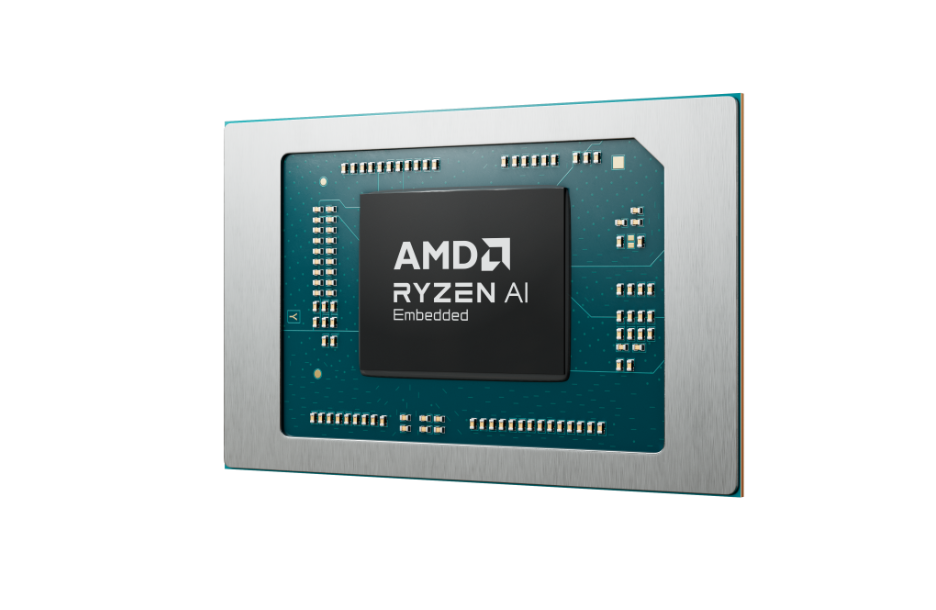

AMD has just introduced a new lineup of x86 Ryzen AI Embedded processors designed to bring more powerful and faster artificial intelligence capabilities to automotive, industrial, and autonomous edge systems. Unveiled at the CES 2026 trade show in Las Vegas, the new Ryzen AI Embedded P100 and X100 Series processors integrate AMD’s latest Zen 5 CPU cores, RDNA 3.5 graphics, and XDNA 2 neural processing units into a single x86 system-on-chip tailored for embedded deployments with limited space and power constraints.
These processors are aimed at driving next-gen digital cockpits, industrial automation platforms, and various physical AI systems like autonomous machines and humanoid robotics. Salil Raje, the senior vice president and general manager of AMD Embedded, highlighted the need for high performance without added complexity in meeting the growing demand for immersive AI experiences and quicker on-device intelligence.
The Ryzen AI Embedded P100 Series, equipped with four to six Zen 5 CPU cores, is optimized for in-vehicle infotainment systems and human-machine interfaces in industrial settings. These processors deliver significant improvements in both single-thread and multithread CPU performance compared to the previous generation, along with enhanced graphics performance supported by the RDNA 3.5 GPU architecture.
Featuring a graphics subsystem capable of supporting up to four 4K displays or two 8K displays concurrently at up to 120 frames per second, the P100 Series also boasts a dedicated video codec engine for high-quality streaming and playback without burdening the CPU. Moreover, the integration of an XDNA 2 NPU in the P100 Series enables low-latency inference for tasks such as voice recognition, gesture control, computer vision, and handling large language models compactly.
In addition to the P100 Series, AMD’s Ryzen AI Embedded portfolio includes the X100 Series catering to more demanding physical AI and autonomous systems by offering higher CPU core counts and increased AI performance. The software stack is based on Xen hypervisor technology for secure isolation of multiple operating system domains, allowing various operating systems like Linux distributions, FreeRTOS, Android, and Windows to operate securely in parallel.
AMD emphasizes that their open-source foundation, long-term OS support, and ASIL-B-capable architecture can help reduce costs, simplify customization, and speed up production for automotive and industrial systems. Early-access customers are already testing AMD Ryzen AI Embedded P100 processors with four to six cores while tools and documentation are set to be available when production shipments start in Q2. The P100 Series processors featuring 8-12 cores for industrial automation applications will commence sampling in Q1. Lastly, the X100 Series processors with up to 16 cores are expected to launch in the first half of this year.