
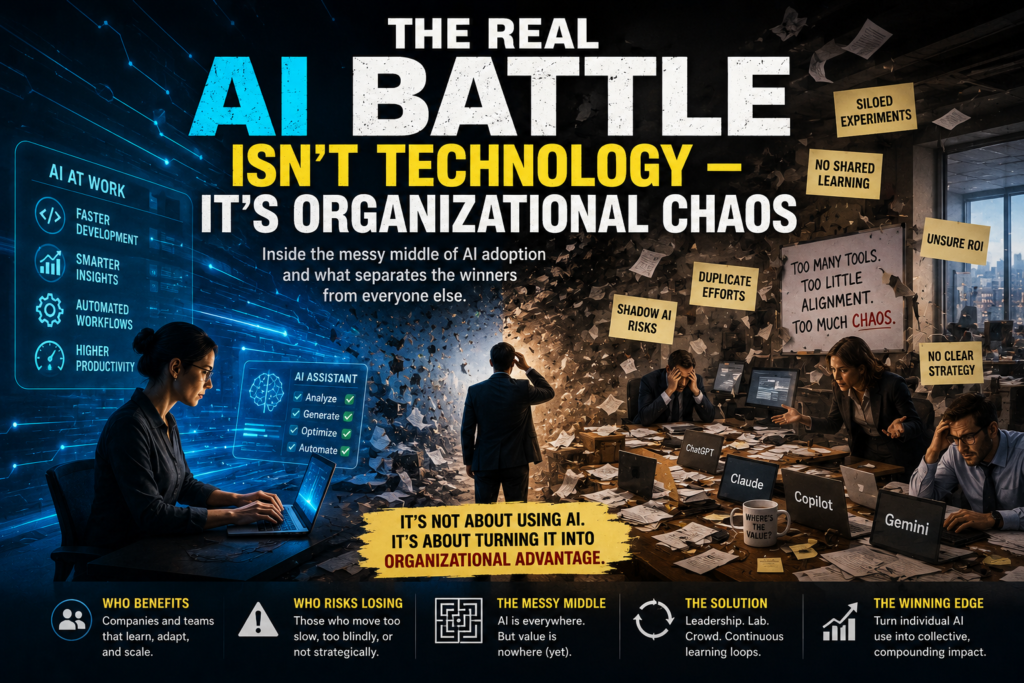
This matters because artificial intelligence is beginning to move beyond being just a productivity tool and is becoming part of how companies actually operate, make decisions, and compete.
For years, businesses treated AI like experimental software. Now companies are entering a phase where AI is quietly reshaping workflows inside departments, teams, and daily operations.
The real shift is not simply that employees are using AI.
The shift is that organizations are trying to figure out how to turn individual AI usage into long-term business advantages.
That is much harder than it sounds.
One employee using AI to work faster does not automatically make the entire company smarter or more profitable. The real challenge is figuring out:
- how knowledge spreads,
- how successful workflows get repeated,
- how AI decisions are monitored,
- and how organizations prevent chaos while still moving quickly.
This is where many companies are entering what experts call the “messy middle” of AI adoption:
- AI is everywhere,
- everyone is experimenting differently,
- some teams are quietly becoming dramatically more efficient,
- while other teams are falling behind without leadership even realizing it.
The companies that solve this problem first may gain enormous competitive advantages in speed, cost savings, research, software development, automation, and decision-making.
Who Benefits?
The biggest winners are likely to be companies and workers who learn how to combine AI with human judgment instead of treating AI like a replacement for people.
Organizations benefit when AI helps:
- speed up development,
- reduce repetitive work,
- improve research,
- identify problems faster,
- prototype products quicker,
- automate workflows,
- and allow smaller teams to produce larger outputs.
Employees who understand how to direct AI effectively may also become far more valuable inside organizations.
A skilled worker using AI properly can sometimes perform work that previously required entire teams.
That creates major advantages for:
- software companies,
- consulting firms,
- financial firms,
- research organizations,
- media companies,
- legal operations,
- and businesses heavily dependent on information processing.
AI infrastructure companies also benefit heavily:
- cloud providers,
- chip manufacturers,
- enterprise software companies,
- cybersecurity firms,
- and AI platform providers.
In many cases, the real winners may not be the companies using AI — but the companies selling the tools powering the AI economy itself.
Who Can Lose — And How?
The biggest risk falls on organizations that mistake AI activity for actual AI transformation.
Many companies are currently buying licenses, deploying chatbots, and encouraging experimentation without truly understanding:
- what is working,
- what is scalable,
- what creates value,
- or what risks are building underneath the surface.
That creates several dangers.
Some companies may waste enormous amounts of money on AI subscriptions and infrastructure without improving productivity enough to justify the cost.
Others may create hidden operational risks:
- employees automating processes without oversight,
- AI-generated mistakes entering workflows,
- inconsistent decision-making,
- security leaks,
- compliance failures,
- or overdependence on systems employees do not fully understand.
Workers can also lose if their jobs are built primarily around repetitive digital tasks.
AI is especially strong at:
- drafting,
- summarizing,
- coding assistance,
- workflow automation,
- document review,
- data analysis,
- and repetitive administrative work.
That does not necessarily mean jobs disappear overnight.
But it can mean:
- fewer workers needed,
- smaller teams,
- compressed hiring,
- lower demand for entry-level positions,
- and increased pressure on employees to produce more output faster.
There is also a risk that knowledge itself becomes weaker over time.
If junior workers rely too heavily on AI-generated outputs without understanding underlying systems, organizations could eventually face skill erosion where employees know how to operate tools but not how to think independently when systems fail.
The Bigger Risk
The companies that lose may not simply be the ones that ignore AI.
The biggest losers could actually be the companies that adopt AI carelessly.
Because once AI becomes deeply integrated into operations, bad decisions scale just as fast as good ones.
And the organizations that survive long term will likely be the ones that understand a critical difference:
Using AI is not the same thing as building intelligence inside the company itself.