
What’s Happening?
A new study is raising concerns about the accuracy of one of the world’s most prominent AI-driven carbon emissions tracking systems.
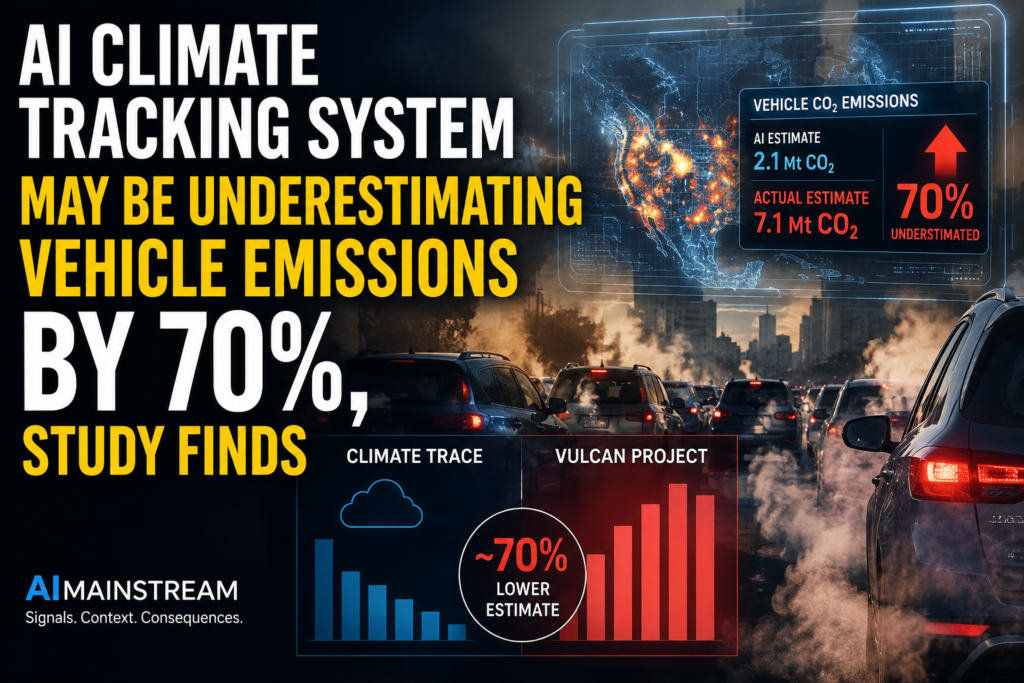
Researchers publishing in Environmental Research Letters claim that Climate TRACE — a high-profile climate monitoring initiative backed by environmental organizations, universities, and former Vice President Al Gore — may be significantly underestimating vehicle-related CO2 emissions in U.S. cities.
According to the study, Climate TRACE’s estimates for on-road vehicle emissions were roughly 70% lower on average than figures produced by the Vulcan Project, a government-funded carbon emissions mapping initiative led by researchers at Northern Arizona University.
The findings suggest that AI-powered emissions monitoring systems may still face major accuracy challenges despite growing adoption in climate policy discussions.
Climate TRACE disputes the conclusions and says its data has been validated against official datasets globally, but researchers behind the study argue the discrepancies warrant closer scrutiny.
Why Does It Matter?
Artificial intelligence is increasingly being used to guide:
climate policy,
emissions regulation,
carbon markets,
ESG investing,
and environmental reporting.
If AI-driven systems produce inaccurate estimates, it could significantly impact:
public policy decisions,
corporate emissions targets,
regulatory enforcement,
and global climate strategies.
The debate also highlights a larger issue emerging across AI industries:
high confidence in AI-generated analysis does not automatically guarantee accuracy.
As governments and institutions increasingly rely on AI-based analytics for critical decision-making, concerns about transparency, model bias, and verification are becoming more important.
Who Benefits?
Potential beneficiaries include:
AI climate analytics companies,
governments seeking scalable emissions monitoring,
ESG investment firms,
environmental organizations,
and corporations tracking sustainability goals.
AI systems can dramatically improve the speed and scale of environmental monitoring compared to traditional reporting methods.
Who Loses?
Potential losers include:
policymakers relying on inaccurate emissions estimates,
cities or industries receiving flawed environmental assessments,
taxpayers funding ineffective climate initiatives,
and organizations making investment decisions based on incomplete data.
There is also a growing risk that overreliance on AI-generated environmental analysis could undermine trust in climate reporting if major discrepancies continue to emerge.
What Happens Next?
The findings will likely increase pressure for:
independent auditing of AI-driven climate models,
greater transparency in emissions methodologies,
cross-validation between AI systems and traditional datasets,
and stricter scientific oversight of environmental analytics.
Climate TRACE says it is reviewing the research and remains open to improving its systems based on new findings.
The larger issue may not be whether AI can assist climate science.
It may be whether governments and institutions move too quickly in treating AI-generated environmental analysis as definitive before fully understanding its limitations.