
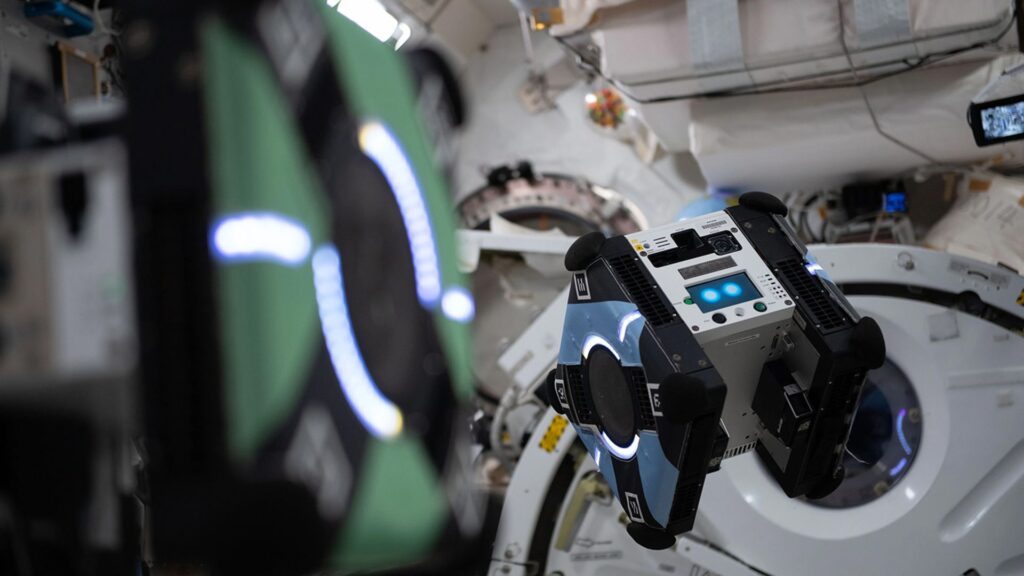
In a weightless setting, manoeuvring can be difficult for both trained astronauts and autonomous robots, posing a particular challenge for the latter when it comes to their utilisation in locations such as space stations. Nonetheless, researchers from Stanford have now employed artificial intelligence to guide an independent robot within the International Space Station (ISS), potentially opening doors for more self-sufficient space missions in the days ahead.
Collaborating with NASA’s cube-shaped Astrobee robot, the Stanford team showcased how a machine-learning system can efficiently chart safe pathways through the ISS’s congested modules much quicker than existing techniques. These advancements tackle a persistent issue in space robotics: how to navigate swiftly and securely with limited computational capabilities and minimal human intervention in one of the most demanding engineering environments imaginable.
Somrita Banerjee, the lead researcher and a Stanford Ph.D. candidate, highlighted the intricacies of motion planning within the station’s intricate layout of equipment and experiments. She explained that traditional algorithms designed for Earth-based robots often struggle when executed on the outdated, radiation-resistant computers approved for space travel.
To overcome these limitations, Banerjee and her team initially adopted a standard optimisation strategy, as detailed in a recent paper presented at the International Conference on Space Robotics. This method breaks down complex motion-planning dilemmas into smaller segments. They then trained an AI model using thousands of precomputed paths, enabling the system to initiate each new plan with an informed “warm start” rather than starting from scratch.
Banerjee elucidated on this approach by comparing it to planning a road trip based on existing routes taken by others instead of drawing a direct line on the map. She emphasised starting with knowledge gained from experience and refining plans accordingly.
By incorporating rigorous safety checks before operations while reducing actual computation time, routes devised with the AI’s warm start were discovered to be approximately 50% to 60% faster during tests on the station compared to conventional plans, according to the researchers.
“This marks a significant milestone as AI has been implemented for robot control aboard the ISS,” Banerjee remarked. “It demonstrates that robots can operate more efficiently without compromising safety, which is crucial for forthcoming missions where human guidance might not always be feasible.”
Prior to conducting tests in orbit, the system underwent validation at NASA’s Ames Research Center in Silicon Valley using a specialised setup resembling microgravity conditions on the ISS. During the orbital trial, astronauts facilitated initial setup procedures before allowing Astrobee to be remotely controlled from Earth in what NASA terms a “crew-minimal” experiment.
Throughout a four-hour session, mission controllers at NASA’s Johnson Space Center directed Astrobee through 18 trajectories, each repeated with and without utilising the AI-generated warm start. Additional precautions like virtual obstacles and emergency stop capabilities were employed to prevent collisions.
The team envisions that similar AI-driven planning could empower robots to handle inspections, logistics, and scientific endeavours on upcoming missions to celestial bodies such as Mars and beyond. This would enable astronauts to concentrate on more critical tasks as robots take on these responsibilities autonomously.
“As we explore farther realms from Earth and missions become more frequent and cost-effective, remotely controlling robots from ground stations may not always be feasible,” Banerjee emphasised. “Autonomy supported by reliable mechanisms is not just beneficial; it is imperative for the evolution of space robotics.”