
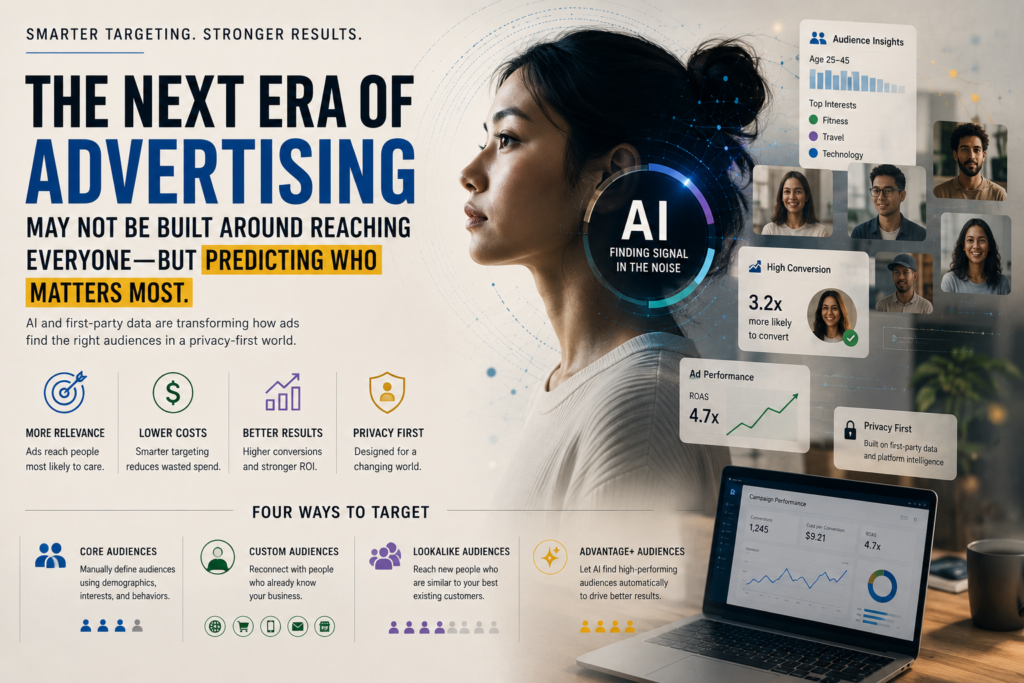
The next era of advertising may not be built around reaching everyone — but predicting who matters most.
What’s happening:
Meta continues expanding AI-driven advertising tools inside Facebook and Instagram, including systems like Advantage+ audience targeting that automatically identify users more likely to respond to ads based on platform data, previous interactions, and conversion patterns.
The advertising system combines multiple targeting methods including:
demographic targeting,
interest-based targeting,
retargeting,
customer list matching,
lookalike audiences,
and AI-assisted optimization.
At the same time, privacy changes introduced in recent years — including Apple’s iOS tracking restrictions — have reduced the effectiveness of some traditional third-party tracking methods, pushing advertisers toward greater reliance on first-party data and AI modeling.
Why it matters:
The larger shift may not simply be about digital advertising.
It reflects how AI is increasingly becoming the infrastructure behind:
recommendation systems,
personalization,
audience prediction,
behavioral analysis,
and automated decision-making across the internet economy.
Supporters argue these systems can improve ad relevance, campaign efficiency, and customer matching while reducing wasted advertising spend.
Critics and privacy advocates continue raising concerns around:
behavioral profiling,
data collection,
transparency,
algorithmic influence,
and how much users understand about how targeting systems operate behind the scenes.
The broader trend is that advertising platforms are moving away from purely manual targeting toward increasingly automated AI-driven optimization systems.
Who benefits:
Businesses seeking more efficient ad targeting
Advertising platforms using AI optimization
Brands leveraging first-party customer data
Marketers focused on conversion performance
Who faces challenges:
Users concerned about privacy and data collection
Smaller advertisers adapting to changing platform rules
Companies affected by reduced third-party tracking access
Regulators evaluating transparency and data governance practices
What happens next:
As privacy regulations evolve and AI systems become more sophisticated, digital advertising will likely continue shifting toward:
predictive modeling,
automated targeting,
server-side data systems,
AI-generated campaign optimization,
and first-party data ecosystems.
The future of online advertising may depend less on manually selecting audiences — and more on how AI systems interpret behavior, intent, and probability at scale.