
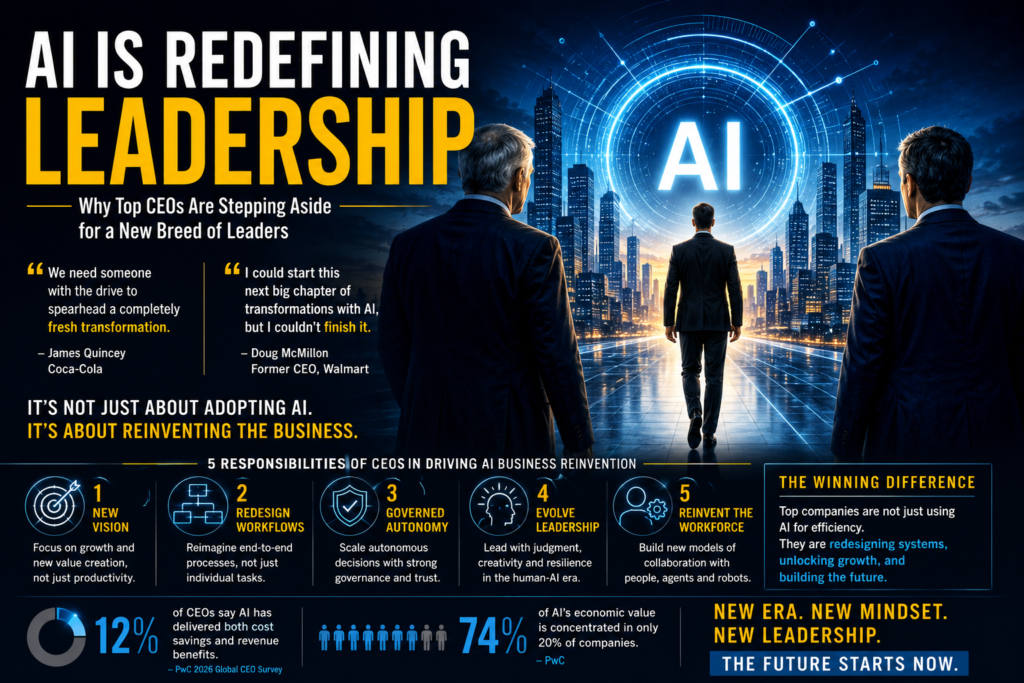
The AI era may not just replace jobs — it may redefine who is qualified to lead.
As major CEOs begin stepping down while openly framing succession around artificial intelligence, something much bigger may be happening beneath the surface:
AI is not just changing business tools.
It may be changing the definition of leadership itself.
Two high-profile examples are now fueling that conversation.
James Quincey signaled that The Coca-Cola Company needed leadership capable of driving an entirely new transformation era, while former Doug McMillon acknowledged that he could begin the company’s AI transformation — but not necessarily finish it. Henrique Braun and John Furner are now stepping into leadership during what may become one of the largest operational reinventions in corporate history.
What makes this notable is that these were not failing executives being pushed aside.
They were successful leaders recognizing that AI may require a fundamentally different operating mindset.
Why It Matters
Many companies still treat AI as an efficiency tool:
- automate tasks
- reduce labor costs
- increase productivity
- improve dashboards
- speed up workflows
But the companies seeing the biggest long-term advantages may be doing something far more aggressive:
They are redesigning the business itself around AI.
That includes:
- rethinking workflows from the ground up
- increasing autonomous decision-making
- restructuring workforce models
- redefining leadership responsibilities
- rebuilding governance systems for AI-era operations
The biggest signal may not be the technology.
It may be the realization that the leaders who built traditional enterprises may not automatically be the leaders best suited to rebuild them for an AI-driven future.
Who Benefits
- AI-native companies built around autonomous workflows
- Leaders willing to redesign entire operating systems
- Firms combining AI with growth and reinvention strategies
- Companies investing early in AI governance and trust systems
Who Loses
- Companies using AI only for short-term efficiency gains
- Leadership teams resistant to structural change
- Businesses optimizing outdated workflows instead of redesigning them
- Organizations waiting for “proven ROI” before adapting
What Happens Next
Boards may increasingly evaluate CEOs based on AI transformation capability — not just quarterly performance.
Future leadership traits may shift toward:
- adaptability
- systems thinking
- AI-human collaboration management
- governance oversight
- creativity under automation pressure
The next generation of CEOs may not simply manage companies.
They may be expected to redesign them in real-time alongside AI systems.