
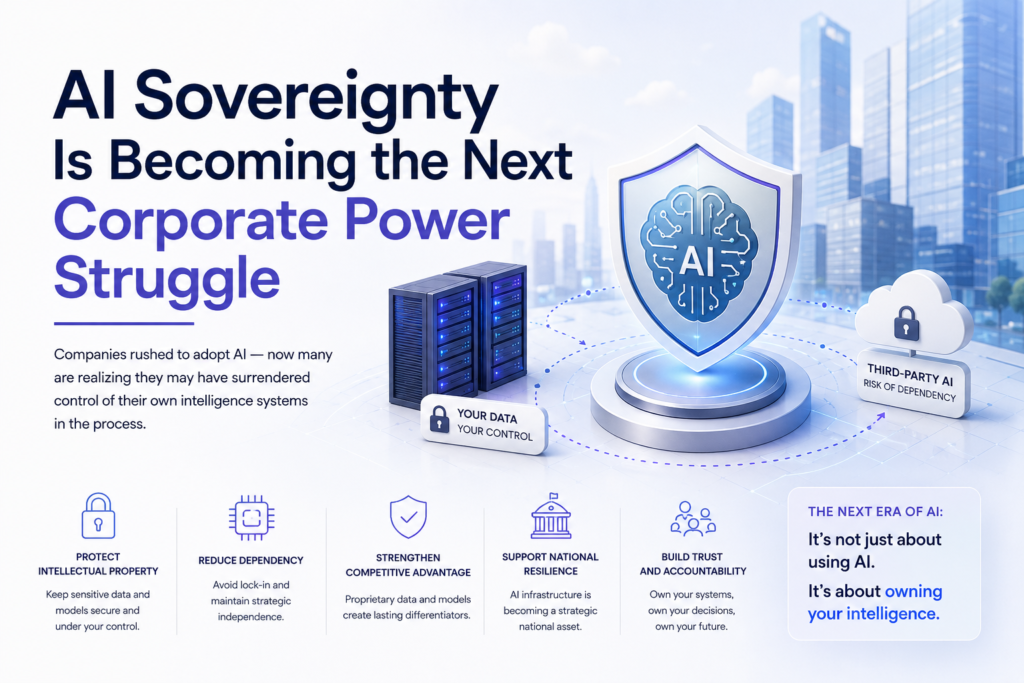
“Companies rushed to adopt AI — now many are realizing they may have surrendered control of their own intelligence systems in the process.”
What’s Happening
As artificial intelligence becomes deeply integrated into business operations, companies are beginning to rethink one of the biggest tradeoffs of the AI boom:
speed versus control.
In the rush to adopt generative AI, many organizations relied heavily on third-party platforms operated by major cloud and AI providers. The convenience allowed businesses to move quickly, automate workflows, analyze internal data, and deploy AI tools across departments faster than ever before.
But a growing number of executives are now questioning the long-term consequences of that decision.
The concern is that companies may be handing over too much control of their:
internal knowledge
proprietary workflows
customer insights
operational intelligence
decision-making infrastructure
to external AI ecosystems they do not own.
This shift is fueling a growing focus on “AI sovereignty” — the idea that businesses and governments should maintain direct control over their own AI systems, infrastructure, data, and intelligence layers.
Why It Matters
The AI race may no longer be defined only by who builds the smartest model.
It may increasingly be defined by who controls the intelligence stack underneath modern business operations.
As AI evolves from a simple productivity assistant into autonomous systems capable of making decisions, executing workflows, managing infrastructure, and interacting with customers, dependency risks become far more serious.
The issue is not simply cybersecurity.
It is strategic dependency.
If a company’s operations become deeply tied to external AI providers, switching away later could become extremely expensive, operationally disruptive, and competitively dangerous.
This is pushing many organizations toward:
private AI environments
sovereign cloud infrastructure
internal AI governance systems
proprietary data ecosystems
on-premise enterprise AI models
The deeper concern is that AI may eventually become as strategically important as:
energy infrastructure
telecommunications
cloud computing
national defense systems
Who Benefits
Enterprise AI infrastructure providers
Sovereign cloud companies
Private AI deployment platforms
AI hardware manufacturers like NVIDIA
Organizations with proprietary datasets and internal AI ecosystems
Who Loses
Companies overly dependent on third-party AI providers
Businesses without internal infrastructure control
Organizations treating AI as only a software tool rather than strategic infrastructure
Smaller firms unable to build sovereign AI capabilities
What Happens Next
The next phase of the AI economy may shift away from:
“Who has the best chatbot?”
toward:
“Who controls the systems making decisions?”
Businesses are likely to invest more aggressively in:
internal AI infrastructure
private model hosting
enterprise governance systems
proprietary training data
secure AI environments
At the national level, governments may increasingly view AI infrastructure as a strategic asset tied directly to economic power, technological independence, and geopolitical influence.
The deeper signal is that the future AI winners may not simply be the companies using AI the most.
They may be the companies that truly own it.