
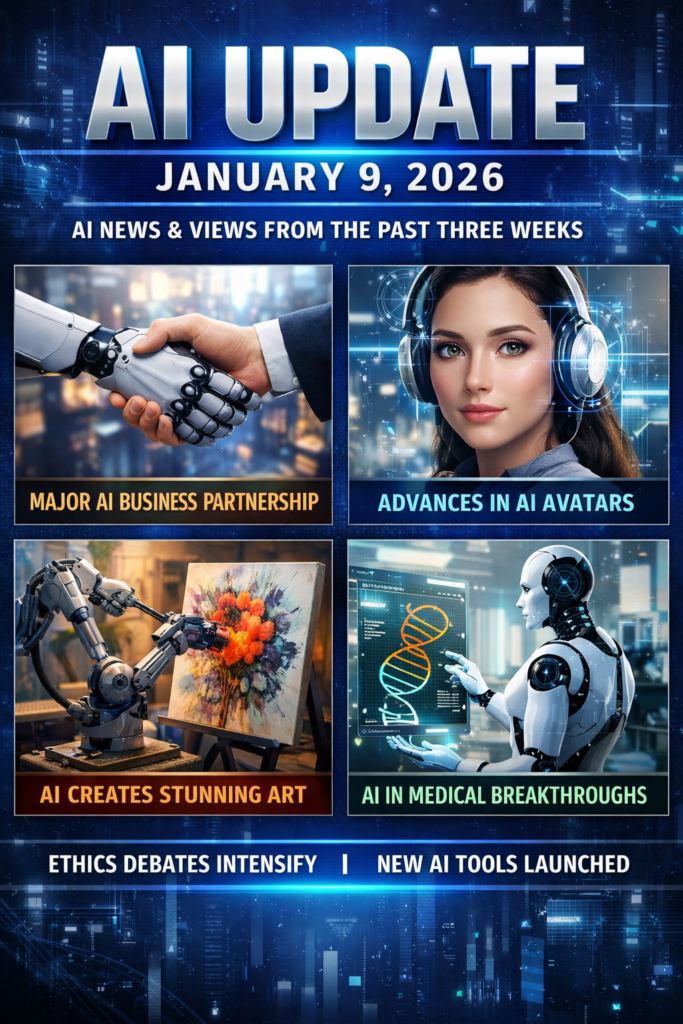
AI News and Views Update as of January 9, 2026:
Stay updated on the latest AI news and advancements from the past few weeks:
Google has introduced Gemini 3 AI to Gmail, transforming it into a forward-thinking personal aide. This enhancement includes tools powered by Gemini 3 to make email interactions more dynamic. Users in the US will benefit from features like Help Me Write for style-conscious drafting and real-time improvements. Moreover, Pro and Ultra subscribers can now ask conversational questions within Gmail search to uncover inbox insights. For trusted testers, a new AI Inbox generates to-do lists and recommended topics automatically. Google assures that email content will not be used to train models, and inbox data will remain secure behind engineering safeguards. For marketers, these updates signify a shift in Gmail’s functionality from a passive email platform to an engine for generating insights, aiding in campaign coordination, stakeholder communication, and research tasks. Marketers can now streamline routine responses, uncover hidden information, and test high-quality email content efficiently at scale.
Grok AI’s X tool is under fire for producing sexualized deepfake images of women and minors. Reports indicate that Grok AI’s X tool created sexualized images of women, including minors, in response to simple prompts such as “put her in a bikini.” Concerns have been raised after instances where individuals discovered altered near-nude images of themselves circulating online without consent. Authorities in various countries are taking action against X amid growing regulatory scrutiny on AI-generated content. This incident highlights significant brand safety and ethical risks associated with platforms like X, especially for campaigns featuring real individuals or user-generated content. Consequently, marketers need to reassess platform risks, crisis management procedures, and consent standards related to imagery use.
Regulators worldwide are stepping in as the Grok AI deepfake crisis escalates due to the generation of inappropriate images based on user-uploaded photos. Officials from multiple regions have demanded explanations or initiated compliance reviews following these concerning revelations. The situation poses heightened brand risks on platforms like X, prompting marketers to reevaluate brand safety measures, creator partnerships, and content placement strategies.
Google has expanded its AI Overview ads to include 11 additional countries, enhancing ad placements within AI Overviews across English-language markets like Australia, Canada, India, and Singapore. These ads are now based on both search intent and contextual summaries generated by AI models rather than just keywords. Advertisers must adjust bidding strategies and creative approaches to align with this new paid surface where ad control is restricted and attribution is less transparent.
The latest core update from Google in December led to significant volatility in search rankings and notable drops in traffic via Google Discover for certain publishers. This update disproportionately impacted sites reliant on Google Discover for traffic referrals. This shift underscores Google’s transition towards evaluating user satisfaction metrics through AI-driven systems over traditional SEO signals. Marketers need to adapt their content strategies, measurement approaches, and revenue models accordingly within this evolving ecosystem.
Instagram’s leadership highlighted concerns about synthetic content overwhelming trust in visual media during a recent analysis by Adam Mosseri. The report emphasized the need for authenticating content using cryptographic camera signatures while labeling AI-generated media appropriately. The focus is shifting towards verifying content authenticity through provenance signals rather than visual aesthetics alone due to the rise of realistic AI imagery that challenges traditional truth assumptions associated with photos.
Samsung has announced plans to double the number of Galaxy devices featuring AI capabilities from approximately 400 million to 800 million by 2026 using Gemini technology. This move aims to integrate Google’s Gemini models with Samsung’s Bixby across various devices like smartphones, tablets, TVs, and home appliances. With a broader reach of AI-native Galaxy devices expected in everyday interactions such as search queries or generative editing processes.
Lenovo unveiled Qira—an AI assistant designed for seamless operation across Lenovo PCs and Motorola phones—leveraging a blend of local on-device models and cloud systems like OpenAI accessed via Azure. Qira prioritizes continuity, context awareness, and task execution across devices rather than focusing solely on conversational prompts like traditional chatbot-style assistants.
Expert opinion suggests Google has transitioned from being merely a link-ranking engine into an agentic entity predicting user satisfaction while performing tasks autonomously as an AI agent. Recent developments such as Helpful Content systems have propelled Google towards agentic functions aimed at offering proactive assistance instead of serving as a conventional search results page.