
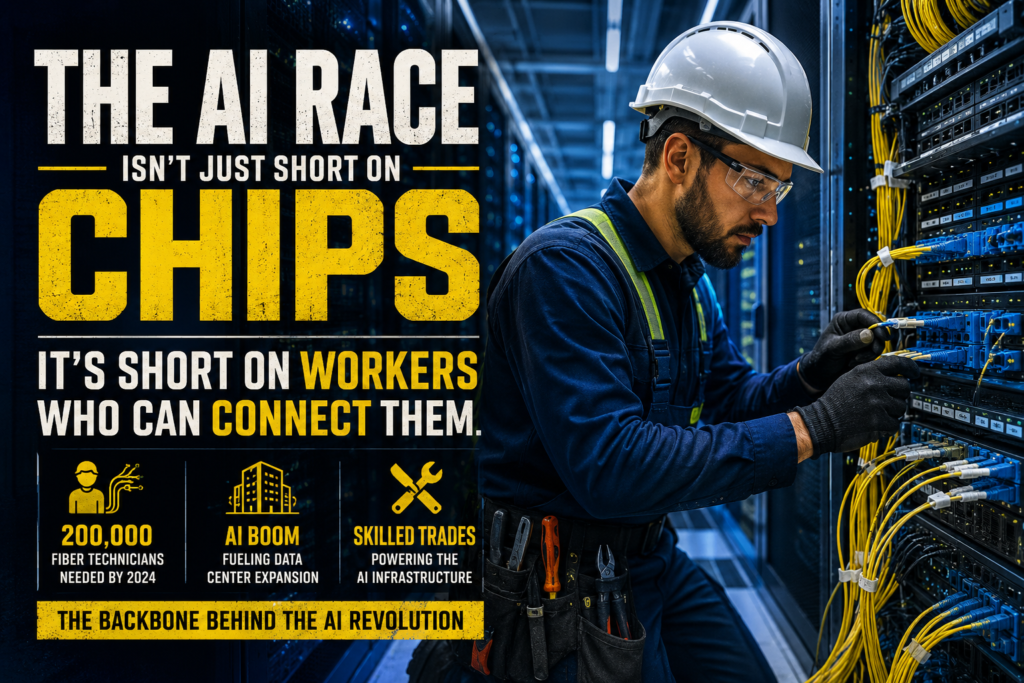
The AI race isn’t just short on chips — it’s short on workers who can connect them.
The AI boom is creating massive demand for a type of worker most people rarely talk about:
Fiber technicians.
As AI companies race to build enormous data centers across the United States, the industry is now facing a shortage of nearly 200,000 fiber-optic and low-voltage technicians needed to wire, connect, and maintain the physical infrastructure powering artificial intelligence.
Companies like Meta are now launching accelerated training programs to help fill the gap.
Why It Matters
Most people think the AI race is only about chips, software, and engineers.
But AI also depends on a huge physical infrastructure layer:
- fiber optics
- power systems
- cooling
- networking
- low-voltage installations
- server connectivity
Without skilled labor to build those systems, AI expansion can slow down — regardless of how advanced the software becomes.
Who Benefits
- Trade workers entering fiber and low-voltage careers
- Vocational training programs
- Data center construction firms
- States attracting AI infrastructure investment
Who Loses
- AI companies competing for scarce labor
- Regions without trained technical workforces
- Smaller contractors struggling to keep up with demand
What Happens Next
The AI economy may quietly create one of the biggest blue-collar infrastructure booms in decades.
But there’s a catch:
many of these jobs may only last through the construction phase before shrinking dramatically once facilities become operational.
The AI revolution may not just reshape digital jobs —
it could temporarily redefine skilled trade labor across America.