
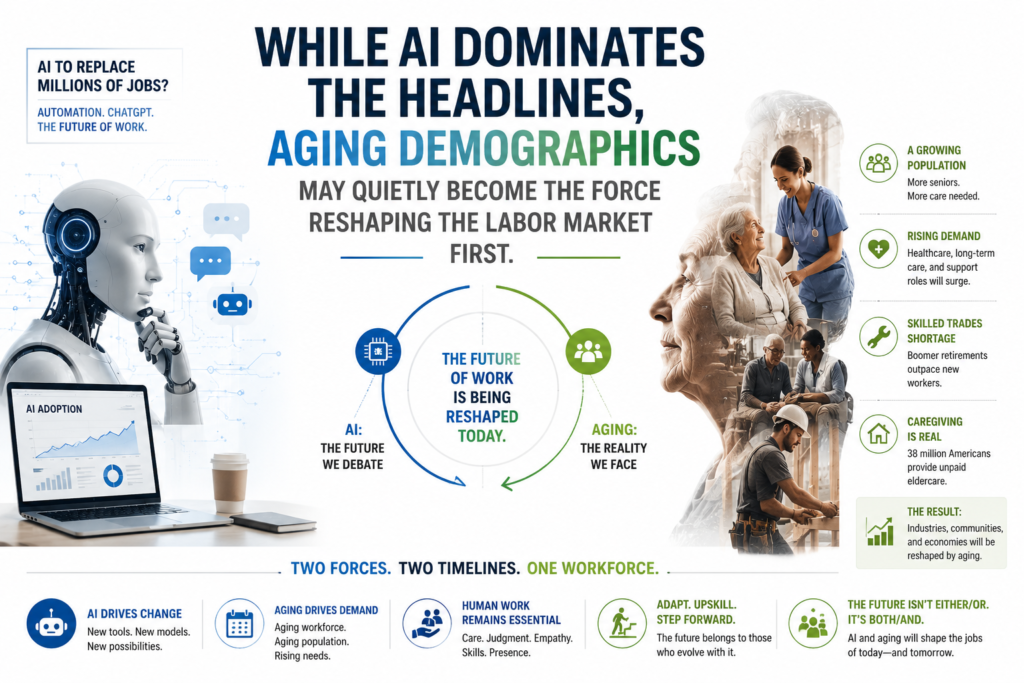
While AI dominates the headlines, aging demographics may quietly become the force reshaping the labor market first.
What’s Happening
Since the launch of ChatGPT in late 2022, fears surrounding artificial intelligence and job displacement have exploded across nearly every industry.
Workers are using AI to increase productivity while simultaneously worrying about replacement. Employers are restructuring teams around automation. Graduates entering the workforce are questioning which careers remain safe long term.
But economists say another force may ultimately have a larger and more immediate impact on the labor market:
aging.
According to economists at ADP Research Institute, the United States economy is rapidly shifting toward a healthcare-centered labor market driven by demographic realities rather than AI disruption alone.
As millions of Americans age into retirement years, demand for healthcare workers, caregivers, nurses, therapists, and support staff is expected to surge.
At the same time, older skilled workers across industries like construction, plumbing, electrical work, and infrastructure are retiring faster than younger workers are replacing them.
That combination is beginning to create a structural labor imbalance.
Why It Matters
The future workforce debate may be focusing too heavily on automation while underestimating demographics.
AI could eventually reshape knowledge work, office jobs, and digital industries.
But aging populations are already reshaping labor demand today.
Healthcare has become one of the few consistently expanding employment sectors in the U.S. economy regardless of recessions or economic cycles. The demand for:
- home health aides,
- nurses,
- long-term care workers,
- therapists,
- and elder support services
continues rising as the population grows older.
At the same time, industries dependent on skilled trade labor are confronting a generational replacement problem.
Many experienced baby boomer workers are retiring with too few younger workers entering the trades to replace them.
That creates a rare labor market dynamic:
AI may reduce demand for some digital jobs while aging simultaneously increases demand for physical, service-based, and human-centered work.
Who Benefits
- Healthcare systems and eldercare providers
- Skilled workers entering healthcare and trades
- Construction and infrastructure sectors needing replacement labor
- Workers in roles requiring physical presence and human trust
- Companies building aging-related services and support technologies
Who Loses
- Industries unable to replace retiring skilled workers
- Families balancing unpaid caregiving responsibilities
- Employers relying on shrinking labor pools
- Lower-paid caregiving workers facing rising demand but limited compensation
- Sectors assuming AI alone can solve workforce shortages
What Happens Next
The next labor market transformation may emerge from two massive forces colliding at the same time:
- AI-driven productivity expansion
- aging-driven labor shortages
That collision could reshape how society values labor itself.
Some digital roles may become increasingly automated.
But healthcare, caregiving, skilled trades, and community-based support systems may become more economically important than many expected.
The result may not be a future with “less work.”
It may become a future where human labor shifts toward areas machines still struggle to replace:
care,
trust,
physical presence,
and human connection.
AI may represent the future of technology.
But aging may become the force that defines the future of work first.