
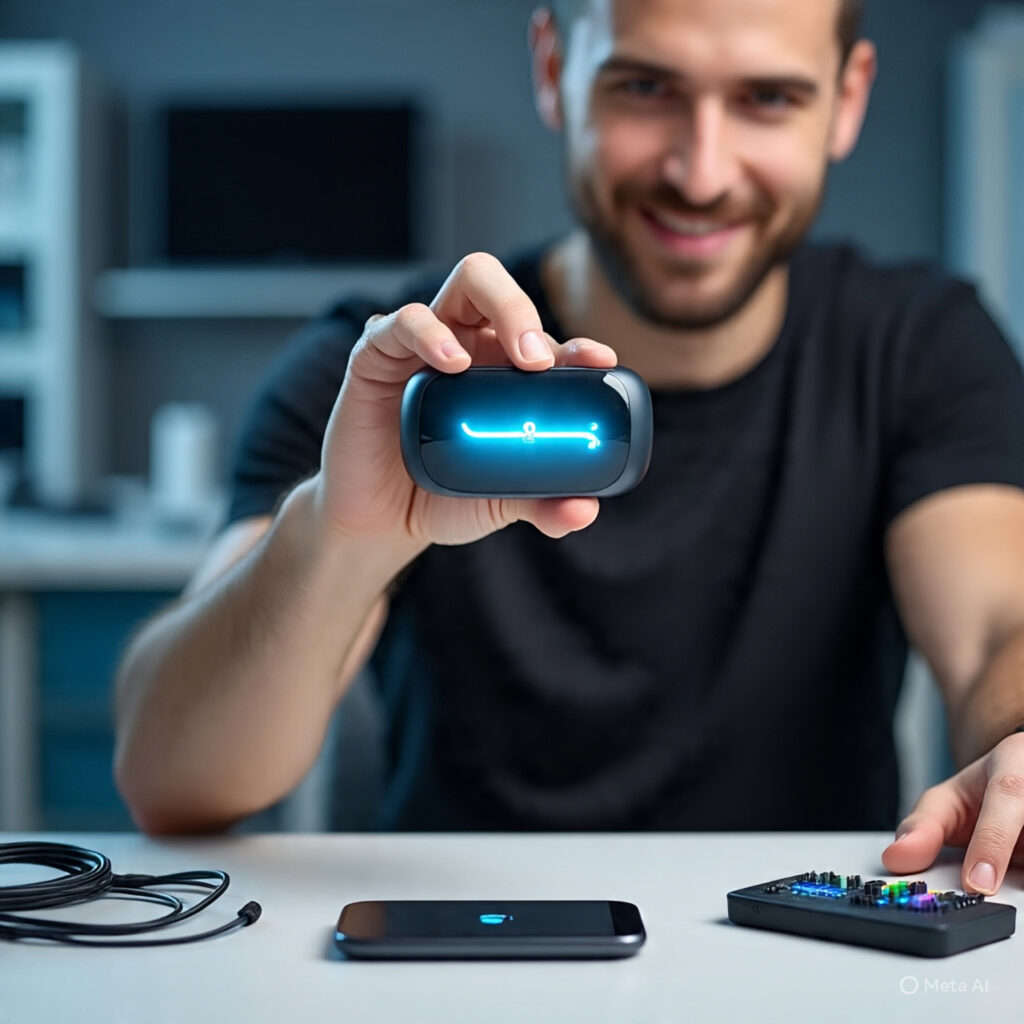
During initial testing of Bee’s review unit, we discovered that the device was user-friendly, requiring just a simple button press to start or stop recording. Within the app, users have the ability to customize settings such as using a double press to bookmark a conversation section, process the current discussion, or both. Additionally, users can choose whether a press-and-hold gesture enables them to leave a voice note or engage with the AI assistant. The companion app prompts users to enable voice notes, ensuring that feature is utilized.
Similar to various other AI products like Plaud, Granola, Fathom, Fireflies, and Otter, Bee has the capability to listen, record, and transcribe audio conversations. However, what sets Bee apart is its approach of segmenting audio into sections and providing summaries for each part instead of offering an overall view or raw transcript. For example, an interview could be segmented into sections such as introduction, detailed product information, industry trends overview, and other discussed topics.
Each section is highlighted with a different background color for easy identification while scrolling. Users can tap on individual sections to view precise transcriptions. One drawback we noted was the lack of an obvious speaker labeling feature within the app. Although tapping on a conversation segment confirms the speaker’s identity, this falls short compared to other professional AI transcribers that allow labeling of each speaker. Furthermore, Bee deletes audio post-transcription, making it unsuitable for situations where playback is necessary for accuracy verification.
Despite these limitations, Bee is not primarily designed as a work tool but rather as an AI companion meant to integrate seamlessly into users’ daily lives. Through integration with Google services, Bee can link recorded conversations to specific tasks such as connecting with someone on LinkedIn after a conference or researching products mentioned during a conversation.
Users can also utilize voice notes as an alternative to traditional note-taking methods. Additionally, Bee’s app includes features like reminiscing about past days’ memories and providing personalized insights as it learns more about the user. There is also an option to confirm and expand on personal facts in a dedicated section similar to other AI chatbots’ memory capabilities.
Amazon has announced plans to introduce more features for Bee in the upcoming year. Unlike rival wearables that constantly listen by default and faced criticism for privacy concerns, Bee requires permission before recording conversations unless in public settings where recording is expected. A visible green light indicates when recording is active.
Feedback on Bee’s sports band revealed it was somewhat fragile as it fell off twice while being worn without much movement. Although the clip-on pin appears sturdier based on initial impressions.
The mobile app’s design surpasses Amazon’s in-house apps like Alexa in terms of usability and aesthetics. However, the concept of utilizing AI specifically for recording conversations to gain insights about users remains largely unproven. The question arises whether such devices are practical for non-professional settings like casual conversations or social interactions.
Moreover, widespread adoption of AI listening devices would necessitate a cultural shift regarding privacy norms and appropriateness. While legalities may permit recording audio in public spaces without consent, societal perceptions may condemn such actions without prior approval.
It’s foreseeable that some individuals may disregard these social norms leading others to self-censor their speech in public settings.
An anecdote shared at CES exemplifies this shift in behavior where an individual joked about amplifying their remarks into an already-recording AI device pinned discreetly on their attire. This scenario underscores the potential realization that private conversations could become “on the record” without explicit consent.
The reception of Bee by consumers will serve as a litmus test for Amazon to determine if there is genuine demand for such technology in society’s evolving landscape.