
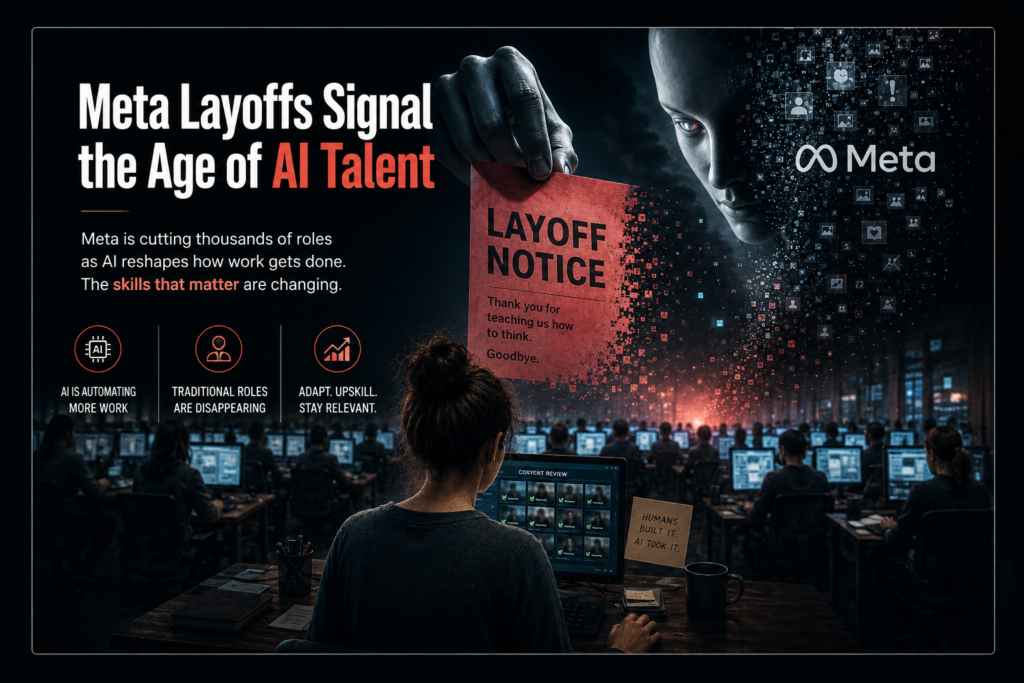
“First They Trained the AI. Then the AI Replaced Them.”
What’s Happening
Hundreds of workers in Ireland who helped train and moderate Meta’s AI systems are facing layoffs as the company pushes deeper into automation and internal AI-driven moderation tools. The workers, employed through Dublin-based outsourcing company Covalen, handled difficult tasks such as labeling harmful content, testing AI safety boundaries, and helping train systems to recognize dangerous material.
Reports suggest more than 700 jobs could be impacted, including roughly 500 AI data annotators.
Why It Matters
This is one of the clearest real-world examples yet of AI replacing the very people who trained it.
These workers were not entry-level button pushers. Many spent years helping teach AI how to identify nuanced human behavior, harmful speech, manipulation tactics, self-harm content, and illegal material. In many ways, they became human “judgment engines” for the AI systems themselves.
That creates a larger question:
How much human expertise gets absorbed into AI systems before those workers are no longer needed?
The experience gained by these employees is significant. Many effectively became specialists in:
- AI safety testing
- Content risk analysis
- Behavioral pattern recognition
- Escalation judgment
- Edge-case moderation
- Policy interpretation under pressure
Some workers reportedly spent hours simulating disturbing or emotionally difficult scenarios so AI systems could learn how to respond appropriately. That is highly specialized operational experience — even if the title “data annotator” sounds simple on paper.
Who Benefits
- Major AI companies reducing long-term labor costs
- Platforms scaling moderation faster through automation
- Investors seeking leaner operations and higher margins
- Companies building enterprise AI moderation systems
Who Could Lose
- Large outsourced moderation workforces
- Entry-to-mid-level digital labor jobs
- Countries building employment sectors around tech outsourcing
- Workers whose expertise becomes embedded into AI models without long-term career protection
What Happens Next
This may become a blueprint across the AI industry.
Companies are increasingly realizing that once AI systems absorb enough human decision-making patterns, they can reduce dependence on the very workforce that trained the models. The next phase may not just be AI replacing repetitive labor — but replacing accumulated human operational judgment itself.
The deeper signal is not simply layoffs.
It is that companies are beginning to treat human expertise as temporary training infrastructure for machine systems.