

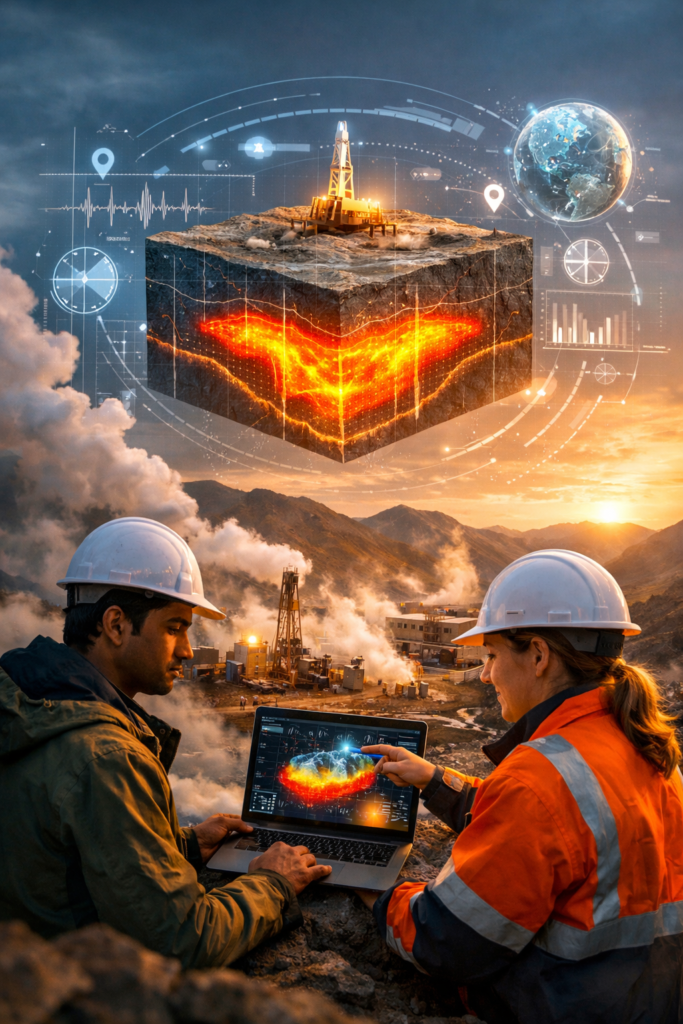
A startup based in Utah recently revealed its use of artificial intelligence to identify a geothermal reservoir reaching temperatures of 250 degrees Fahrenheit, as reported by CNN. The company plans to commence electricity generation within three to five years, with one geologist suggesting that AI could revolutionize the geothermal industry.
Known as “Big Blind,” the site discovered by Zanskar Geothermal & Minerals lacks visible indicators like hot springs or geysers and has no prior history of geothermal exploration, categorizing it as a “blind” system. This marks the first blind site uncovered by the industry in more than thirty years, according to Carl Hoiland, Zanskar’s co-founder and CEO. Hoiland expressed to CNN that the notion of geothermal energy being fully utilized has persisted for decades, but he believes there are numerous hidden sites throughout the Western United States waiting to be discovered.
Geothermal energy holds promise as a transformative force due to its potential to serve as a vast source of clean energy to satisfy growing demand. Unlike wind and solar power, which rely on specific weather conditions, geothermal energy is nearly limitless, emits minimal climate pollutants, and remains consistently available. The challenge has been in identifying and expanding its utilization, necessitating specific geological conditions such as underground reservoirs containing hot water or steam within porous rocks that enable water circulation for powering turbines.
Zanskar utilizes AI models that analyze existing blind systems data gathered over centuries from accidental discoveries made during resource drilling operations worldwide. By scrutinizing vast datasets encompassing rock characteristics and magnetic fields, these models can discern patterns indicative of potential geothermal reserves. Hoiland noted that AI capabilities have significantly improved over the past decade in extracting meaningful signals from noise.
James Faulds, a geosciences professor at Nevada Bureau of Mines and Geology, emphasized the significance of Zanskar’s discovery by pointing out that a considerable portion of US geothermal resources are blind. He suggested that refining methodologies for detecting such systems could unlock substantial gigawatt potentials within the western United States alone.
While “Big Blind” represents Zanskar’s inaugural blind site discovery, it marks the third successful commercial resource location out of three drilled sites. Hoiland envisions multiple new sites entering the market in the future and asserts that Zanskar’s efforts underscore the vast untapped potential of conventional geothermal energy.
Credit goes to long-time Slashdot reader schwit1 for sharing this article.