
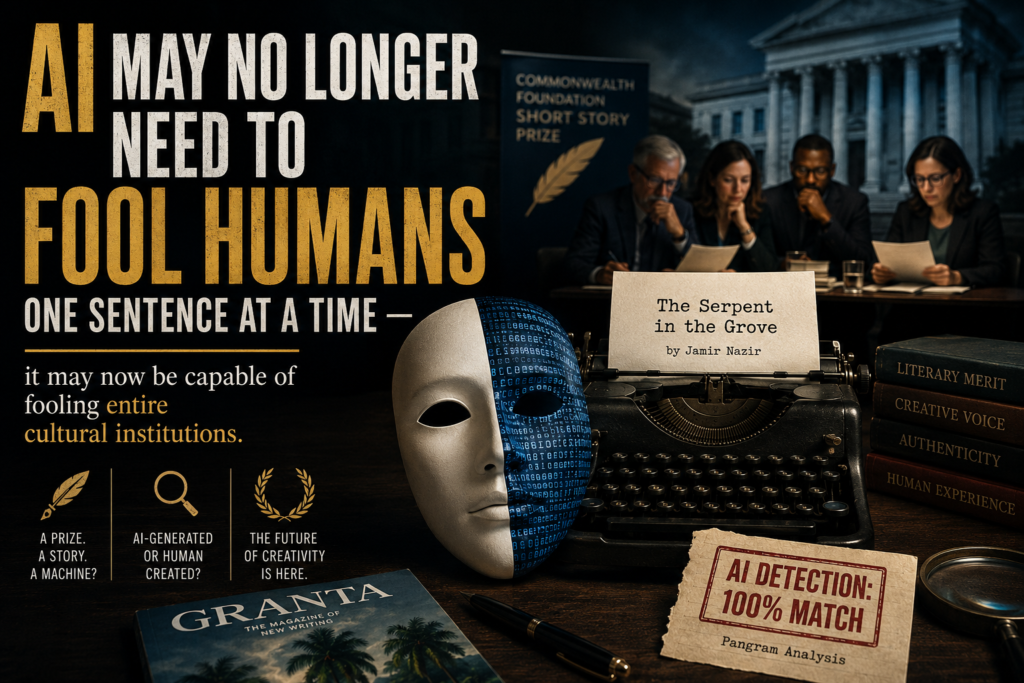
AI may no longer need to fool humans one sentence at a time — it may now be capable of fooling entire cultural institutions.
What’s Happening
A growing controversy inside the literary world is reigniting one of the biggest unanswered questions surrounding generative AI:
Can humans still reliably distinguish machine creativity from human creativity?
The debate intensified after a short story published in the prestigious literary magazine Granta was flagged as potentially AI-generated. The story, “The Serpent in the Grove” by Jamir Nazir, had already advanced as a regional finalist in the Commonwealth Foundation Short Story Prize after being selected from more than 7,800 submissions.
Judges praised the story’s vivid imagery, poetic structure, and polished prose.
But suspicions quickly emerged online.
Ethan Mollick analyzed the piece publicly and reportedly tested it using AI-detection software that claimed an extremely high probability of machine-generated writing. Online investigators also struggled to verify the author’s broader literary background, further fueling speculation.
The controversy has now expanded far beyond a single story.
It is forcing publishers, literary awards, educators, and creative institutions to confront a rapidly growing reality:
AI-generated writing may already be crossing the threshold where even experienced experts cannot confidently identify it.
Why It Matters
This story is not really about one author.
It is about whether traditional systems used to evaluate originality, creativity, and human expression are beginning to break down.
For years, many people assumed AI-generated writing would remain easy to spot because it would sound robotic, repetitive, or emotionally shallow.
That assumption is weakening quickly.
Modern AI systems are now capable of producing:
- emotionally layered prose,
- stylistic imitation,
- poetic symbolism,
- literary pacing,
- and highly polished narrative structures.
In many cases, AI does not need to create “perfect” literature to disrupt creative industries.
It only needs to become good enough to consistently pass human judgment systems.
That changes the pressure facing:
- publishers,
- schools,
- journalism,
- screenwriting,
- marketing,
- advertising,
- and entertainment industries.
The deeper issue may become trust itself.
If audiences no longer know whether creative work came from human experience or machine synthesis, entire industries may eventually need new disclosure standards, authentication systems, or “proof-of-human” creative verification.
Who Benefits
- AI companies developing advanced language models
- Writers using AI as collaborative creative tools
- Content platforms able to scale production rapidly
- Independent creators who can amplify output with AI assistance
Who Loses
- Traditional gatekeeping systems built around human originality
- Literary institutions struggling to verify authenticity
- Human writers competing against machine-scale productivity
- Audiences seeking confidence in fully human-created art
What Happens Next
This may become one of the first major literary-world “AI authenticity” flashpoints — but it likely will not be the last.
As AI writing quality continues improving, creative industries may split into multiple camps:
- full AI acceptance,
- AI-assisted disclosure requirements,
- verified human-only competitions,
- or hybrid creative categories.
The long-term issue may extend beyond literature entirely.
The real disruption could emerge when society can no longer reliably determine whether intelligence, creativity, persuasion, or emotion originated from a human mind — or from a machine trained on humanity itself.