
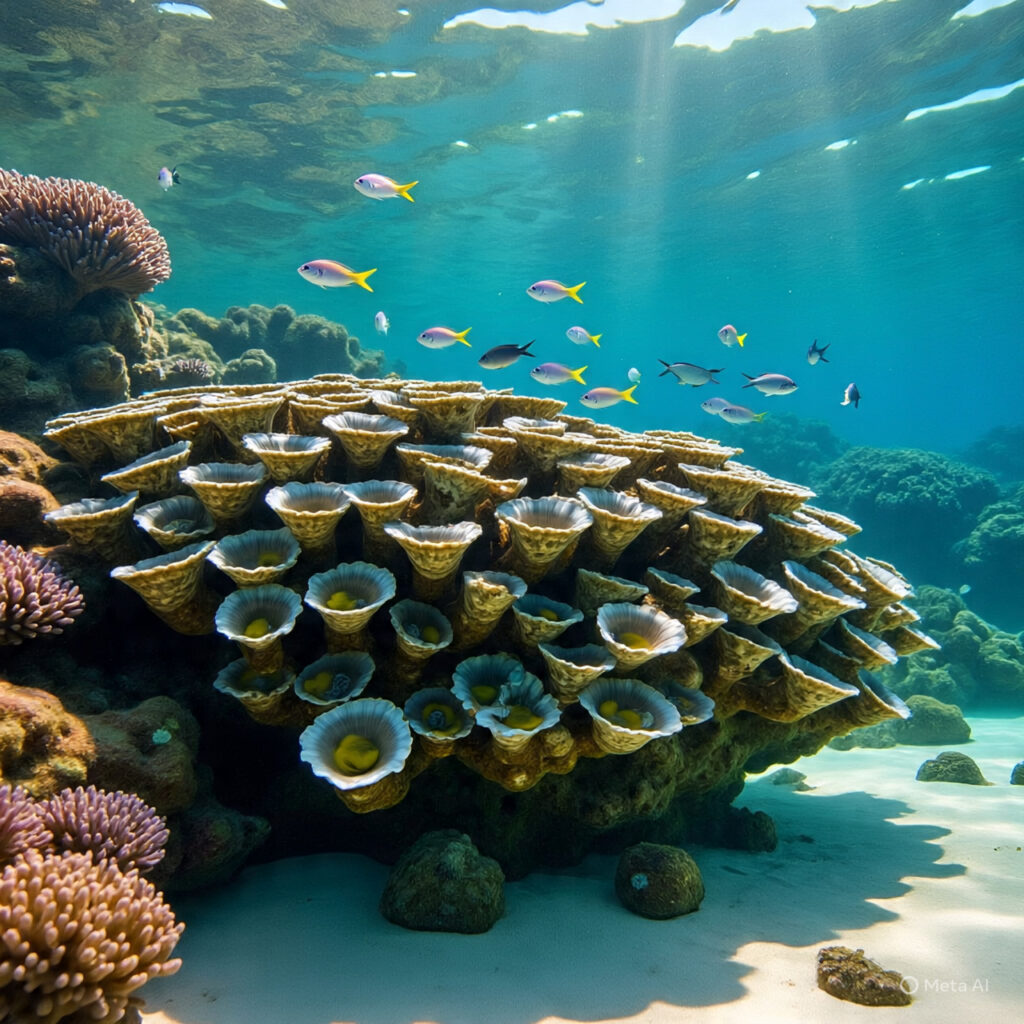
The spatial structure of natural environments plays a crucial role in determining the diversity of species, the amount of biomass that can be harvested, and the ability of ecosystems to withstand disturbances. Certain species, such as trees, corals, and oysters, influence the availability of resources and alter both living and non-living pressures by creating their own three-dimensional structures. This enhances their chances of survival. However, empirical studies rarely investigate which specific aspects of the three-dimensional architecture of these ecosystem engineers impact ecosystem dynamics and species survival. This gap in research limits our understanding of the broader ecological and conservation implications of ecosystem engineering.
Our research demonstrates that oyster reefs possess unique geometric characteristics that enhance the survival of new recruits, a critical factor for the growth and longevity of oyster reefs. By analyzing a range of natural oyster reef architectures and applying a geometric theory that correlates habitat surface area with fractal dimension and height, we found that certain combinations of fractal dimension and height promote optimal oyster settlement and survival by reducing predation.
Our study offers a framework for identifying the most effective three-dimensional habitat configurations for global habitat restoration initiatives without overlooking key architectural elements crucial for successful restoration. Habitat structural complexity is a driving force behind species abundance and biodiversity across various ecosystems on Earth. Complex three-dimensional habitats tend to support larger populations due to increased surface area, which in turn amplifies with habitat complexity. Additionally, complex habitats provide additional benefits to species by mitigating environmental stresses and interactions between organisms.
In many cases, structurally intricate habitats are created by ecosystem engineers—organisms that manipulate materials in their environment to change resource availability. These modifications can significantly impact species distribution, abundance, and trophic relationships. In marine environments, complex habitats can offer protection against predators by creating sheltered microhabitats along intertidal shorelines.
For organisms like corals and oysters that build reefs using planktonic larvae, the intricate structures formed over time provide suitable settlement sites for new individuals while offering protection from predators and environmental stressors. Despite this, establishing clear connections between the structural attributes of invertebrate reefs and key ecological processes influencing population dynamics has been challenging due to limitations in measuring habitat complexity accurately.
Our study investigates whether reef-building oysters construct reefs with specific levels of habitat structural complexity that enhance recruit survival by minimizing predation pressure on young oysters. We focus on two geometric descriptors—fractal dimension and height range—to understand how they influence oyster recruitment through predator mitigation.
Fractal dimension measures how reef surfaces occupy three-dimensional space while height range determines the vertical extent within a planar area occupied by reef structures. By combining these metrics using mathematical relationships, we can describe habitat structural complexity based on two continuous variables.
Through our experiments with artificial larval settlement habitats representing various levels of fractal dimension and height range deployed across different estuaries with or without predator exclusion cages, we aimed to determine how habitat complexity impacts oyster recruitment beyond just surface area effects. Our findings suggest that increasing habitat structural complexity provides benefits beyond simple area expansion by influencing predator-prey interactions.
The relationship between fractal dimension, height range, and oyster densities differed between caged and uncaged habitats, highlighting the role each geometric descriptor plays in mediating predation on oyster recruits. Our results indicate that low levels of fractal dimension and height range benefit oyster recruitment through predator mitigation but diminish in effectiveness as complexity increases.
Increasing habitat structural complexity can create predator-free microhabitats within habitats through compartmentalization. Our study supports the idea that reef-building oysters design reefs with levels of structural complexity optimized for recruit survival by reducing predation pressure.
As global efforts to restore marine and terrestrial habitats expand, incorporating nature-inspired designs based on our findings could enhance restoration success by prioritizing specific combinations of geometric descriptors to maximize recruitment potential. Our study underscores the importance of considering both fractal dimension and height range together when aiming to optimize oyster recruitment for restoration projects.